Money, Family & Boundaries
How a Birmingham Auntie Helped One African Woman Stop Panic Transfers and Protect Her Household in 30 Days

If one “Please, it’s urgent” message can make your chest tighten, send you straight to your banking app or push you into money you had already set aside for rent, Council Tax or food—read every word on this page.
You know the pattern.
Your phone lights up. A voice note arrives from home. Before you even hear the amount, your mind starts calculating.
What can I move? Which bill can wait? Can I use the overdraft and replace it after payday?
You have tried sending a little. But the “little” became the amount everybody expected.
You have tried explaining that life in Britain is expensive. They heard the word “pounds” and still imagined you had plenty.
You have tried ignoring the message for a few hours. Then the second message came. Then the missed calls. Then another relative appeared to remind you what the family did for you.
So you sent it.
Relief came first. For ten minutes, perhaps. Then you saw what was left in your account.
Now the weekly shop goes on a credit card. Your savings wait another month. You pray the car does not develop a fault. You avoid showing your partner the transfer receipt because you already know the argument.
The hardest part is not always the money.
It is feeling that you must choose between being a good daughter and being responsible inside your own home.
It is hearing “You have changed since you travelled” when the truth is that your rent changed. Your childcare changed. Your energy bill changed. Your obligations multiplied.
It is the quiet resentment that follows a transfer you did not freely choose—and the shame you feel for resenting people you genuinely love.
And when your partner asks, “How much did you send this time?” the question is no longer about one payment.
It is about trust. Plans. The deposit you keep postponing. The emergency fund that never becomes an emergency fund because somebody else’s emergency reaches it first.
“I know the pressure. Because the same pattern appears in woman after woman’s story.”
My Name Is Amara Okafor

I am not a financial adviser. Not a therapist. I am the creator of practical money-boundary tools for African women at home and abroad.
Over and over, I kept seeing the same impossible choice: protect your household and feel selfish, or rescue everybody else and quietly damage your own finances.
The names changed. The cities changed. The request changed from school fees to rent, medicine, funerals or business money.
But the emotional machinery stayed the same.
A woman in Birmingham would finish a long shift and discover three missed WhatsApp calls. A woman in Manchester would hide a transfer from her husband. A woman in London would use a credit card for groceries after sending money from her current account.
They were not careless women.
They budgeted. They worked. They tried to save. They understood direct debits, rent dates and the danger of overdraft fees.
Yet one urgent message could make the budget disappear.
Advice like “just say no” failed because it ignored history. Some parents had sold land to educate their daughters. Aunties had cared for children. Siblings had shared food. Gratitude was real.
But gratitude had become a blank cheque.
The question nobody was asking was not, “Do you love your family?”
It was: “Can you support them without making your own household pay the hidden price?”
The Saturday Conversation That Changed the Question
The composite story that follows brings several common UK-diaspora experiences into one account.
We will call the woman Nneka. She was thirty-six, lived in Birmingham, worked rotating shifts and had two children. One Saturday, she attended a small family gathering after a church thanksgiving service.
It was the usual kind of afternoon. Foil trays on the table. Children moving between rooms. Aunties discussing work, school and who had not phoned home enough.
Nneka’s phone vibrated while she was carrying plates into the kitchen.
Her cousin needed £280 for school fees. The message said the children would be sent home on Monday.
Nneka opened her banking app. She had £412 left. Council Tax and two direct debits had not yet gone out.
Auntie Bisi, an older family friend in this composite story, noticed the way Nneka’s face changed.
Nneka tried to smile. She turned the screen down. But Auntie Bisi had already recognised the look: fear dressed as responsibility.
Nneka felt ashamed that one message could make her own home feel unsafe.
The Discovery That Changed Everything
Later, Auntie Bisi found her standing alone near the sink.
She did not ask, “Why are you refusing to help?”
She asked a different question.
“Who protects the home you live in while you rescue the home you left?”
Nneka cried.
Not the neat kind of tears you wipe away before anybody notices. The tired kind. The kind that had been waiting behind every “I will sort it out” she had said for years.
She admitted that she had used her overdraft twice that year after family transfers. Her husband knew about one. He did not know about the other.
Auntie Bisi, in the composite story:
“My daughter, helping is good. But answering before you check your own responsibilities is not generosity. It is panic. You people abroad are carrying everybody’s emergencies as if the word ‘urgent’ manufactures money. It does not.”
Auntie Bisi continued:
“Every time the message comes, guilt runs ahead of your budget. You send first and calculate later. Then your own home carries the shortage. The request may be real, but the money still has to come from somewhere.”
The Big Idea: The Problem Is Not Generosity. It Is Decision-Making Under Guilt.
An urgent request creates pressure. It does not create available money.
When guilt answers before your budget does, the request bypasses rent, food, transport, debt payments, savings and the people who depend on you in Britain.
The more often you rescue without a limit, the more likely the family is to treat your response as the plan. The emergency is not merely recurring. Your instant answer may be helping to recreate the pattern.
You do not need to stop caring. You need a firewall between the message and the transfer.
“The request may be urgent. Your answer does not have to be.”
Nneka sat with that sentence.
She thought about the overtime swallowed by transfers. The savings she kept restarting. The arguments that appeared whenever her husband discovered another payment after the fact.
For years, she had asked only, “How can I find the money?”
That Saturday, she asked, “Is this money safe to send—and what am I actually being asked to fund?”
That is the thinking behind the PAUSE Remittance Firewall™: a practical five-gate system used before a family money decision.
It is not a trick for becoming cold. It is not an automatic “no.” It is a way to decide whether to help fully, help partly, pay a provider directly, share the cost, offer non-cash help or decline.
Auntie Bisi’s final instruction in the composite story:
“Check your own home first. Ask what the money is for. Decide your limit. Then answer once. Do not negotiate against yourself because somebody is unhappy.”
The First Few Days: Nothing Outside Changed
On Day 1, Nneka’s family still had needs. Her bills still existed. Her guilt did not disappear because she had heard one useful sentence.
She did one thing differently: she stopped answering money requests immediately.
Her first reply was simple: “I have seen your message. Let me check my commitments and I will come back to you tomorrow.”
On Day 2, she listed the money her UK household needed before the next payday. Rent. Council Tax. Transport. Food. Childcare. Minimum debt payments. A small emergency buffer.
On Day 3, she looked at the transfer that had triggered the panic. The school fee was real—but the full £280 was not due on Monday. The school allowed instalments.
On Day 4, doubt arrived. She worried that asking questions made her difficult. She nearly sent the full amount just to end the discomfort.
Then she remembered: discomfort is not proof that a boundary is wrong.
Day 5: The First Safe Answer
Nneka calculated what the guide calls her Safe-to-Help Amount.
It was not £280.
It was £60.
She offered £60, paid directly to the school and asked which other adults were sharing the remaining balance.
The cousin was disappointed. Nneka felt the old pull in her stomach.
But her own direct debits cleared.
For the first time, helping somebody else did not create a secret emergency in her own account.
Week Two. Week Three. Then Something Quiet Shifted.
A funeral contribution arrived next. Nneka did not borrow to protect her name. She gave an affordable amount and did not explain it five different ways.
Then a business request came from a relative whose earlier “loan” had never returned. She treated the new request as a potential gift before deciding. The answer became no.
By the fourth week, she noticed something that surprised her.
A family message arrived while she was making dinner—and she did not open her banking app first.
She opened her decision checklist.
“For years, every request felt like a command. That month, it finally became a decision.”
But the real test was waiting inside her own home.
Friday Night
After the children were asleep, Nneka sat beside her husband with her phone, her figures and the transfer history.
She told him about the overdraft payment he did not know about.
He was quiet.
Not because £80 would destroy them. Because secrecy had started to feel normal.
Nneka showed him the new Home-First Number. She showed him the Family Support Pot she wanted to use. She showed him the rule: no transfer before checking what their household had already committed.
“I am not abandoning anybody,” she said. “I am stopping their emergency from becoming ours.”
Her husband looked at the page again.
“That,” he said, “is the first plan we have had for this.”
Nneka cried afterward. Not from shame. From the relief of bringing the whole truth back into the room.
“He did not hold me like I had chosen him over my family. He held me like we were finally on the same side of the decision.”
Different Requests. The Same Hidden Pattern.
The following are illustrative composite scenarios, not customer testimonials. They show how the PAUSE tools apply to common situations African women in the UK describe.
No invented buyer is being presented as real. Replace this section with verified, permission-based customer feedback only after you collect it.
Illustrative composite scenario — not a testimonial
Chioma, 35 — Manchester
Her brother’s rent shortage returned every few months. She used the Four-Box Request Test and saw “repeated rescue,” not a new emergency. Instead of paying again, she offered to help him build a plan and kept her cash inside her household.
Illustrative composite scenario — not a testimonial
Abena, 42 — Croydon
Her mother’s medicine was a genuine, recurring responsibility. Abena agreed a fixed monthly amount with her siblings and put it inside her Family Support Pot. The same need stopped arriving as a fresh crisis every month.
Illustrative composite scenario — not a testimonial
Fatou, 39 — Leeds
A ceremony contribution was presented as compulsory. Fatou checked her Safe-to-Help Amount, offered less and refused to use her credit card to protect appearances. She honoured the occasion without financing it for months.
Illustrative composite scenario — not a testimonial
Zainab, 31 — Nottingham
A cousin wanted a business loan after two earlier loans were never repaid. Zainab stopped calling the money a loan simply because repayment had been promised. She declined cash and offered practical help with the business figures instead.
Illustrative composite scenario — not a testimonial
Efua, 37 — London
She had been answering voice notes while guilt was speaking. Her first change was the pause message: “I have seen this. Let me check and come back to you.” The extra hours did not manufacture money; they gave her enough space to see what was already committed.
Different city. Different request. Same decision gates: Pause. Audit. Unmask. Set. End.
Why I Am Sharing This
I did not create this guide because African women need another lecture about budgeting.
Many already know how to budget. The problem is that guilt can overrule the budget before the numbers are even checked.
I documented the PAUSE Remittance Firewall™ because women need language for the exact moment the request arrives—not only good intentions after the money has gone.
The principle behind the guide:
“You were never selfish for protecting the people who depend on you. You were simply missing a fair system for deciding when help is safe.”
Now Available
PAUSE Remittance Firewall™
The African Woman Abroad’s Guide to Supporting Family Without Sacrificing Her Own Household
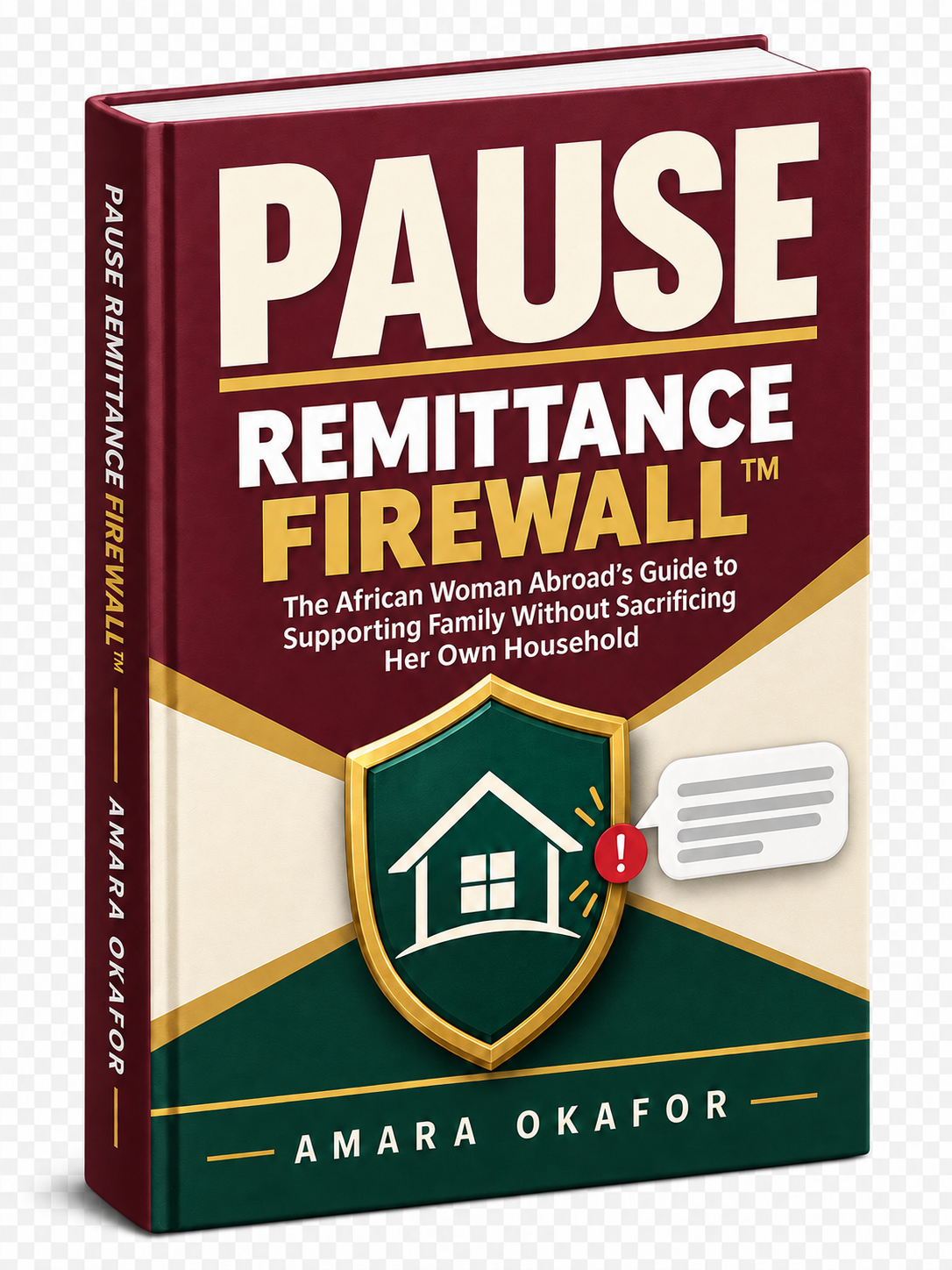
Everything you need to place five practical gates between an emotional request and your money—written in plain language, grounded in real household figures and designed for the moment your phone lights up.
- The WhatsApp Guilt Loop™ — see why an “urgent” message can bypass a sensible budget before you realise what happened. Page 8
- The First-Response Pause — use a prepared sentence that gives you time without starting a family fight. Page 11
- Your Home-First Number — identify the money that must remain protected for rent, Council Tax, food, transport, debt and basic safety. Page 14
- Your Safe-to-Help Amount — calculate what can leave your account without creating a new emergency at home. Page 14
- The Four-Box Request Test — separate genuine emergency, planned responsibility, repeated rescue and lifestyle request. Page 18
- The Family Support Pot — give generosity a fixed place in the budget before anybody asks. Page 22
- The One-Answer Boundary — end days of bargaining, repeated explanations and guilt-driven reversals. Page 26
- The 30-Day PAUSE Plan and Toolkit — turn the framework into a repeatable household habit with worksheets and scripts. Pages 30–42
You do not need an app, a financial planner or another bank account to begin. You need your real household figures, a recent transfer history and a willingness to delay your answer until you have checked both.
Important: This guide provides general educational information. It is not personal financial, legal or therapeutic advice.
Compare £5 With What Panic Transfers May Already Be Costing You
- ✗ One unplanned £100 transfer — then using a credit card for food because the current account is short.
- ✗ Overdraft charges or interest — a second cost created after the first problem has already been funded.
- ✗ A delayed emergency fund — money repeatedly removed before your own boiler, car or immigration expense arrives.
- ✗ Cancelled personal plans — the course, savings goal, child’s activity or weekend that keeps being postponed.
- ✗ Repeated-rescue money — paying the same person’s shortage without any change after the payment.
- The real cost—the one no transfer receipt records: secrecy, resentment and the fear that your partner or children always come second.
How Much Does This Guide Cost?
The fair question is not, “How much money was invented as a production cost?” No made-up figure belongs on this page.
The honest value comes from the work inside:
- A complete five-gate decision framework.
- Household-protection calculations you can repeat every month.
- A request-classification tool for school fees, rent, medical costs, ceremonies and business requests.
- Scripts that help you answer without aggression or a five-day argument.
- A 30-day implementation plan and practical toolkit.
The normal guide price is £15.
But while this introductory offer is displayed, you can get the complete guide—and the Bonus 1 Script Vault—for:
Introductory Digital Offer
PAUSE Remittance Firewall™
One-time payment for the main guide plus Bonus 1.
This is a price-based offer, not a fake countdown. If this page displays £5, the current advertised price is £5.
Get PAUSE Remittance Firewall™ for £5Once You Click That Button, Here Is What Should Happen
- You go to the secure checkout page. The live payment link must be added before this advertorial is published.
- You complete the one-time £5 payment. Your chosen checkout provider handles the transaction.
- You receive the main guide and Bonus 1. Configure automated email delivery—or email plus WhatsApp delivery—before launch, then replace this sentence with the exact delivery time you can genuinely promise.
What a Boundary Can Sound Like in the First 30 Days
Illustrative conversations. Practical words. No invented customer results.
Wait—I Have Something Practical for the Moment Your Mind Goes Blank
The guide teaches you how to decide. Bonus 1 helps you find the words after you have decided.
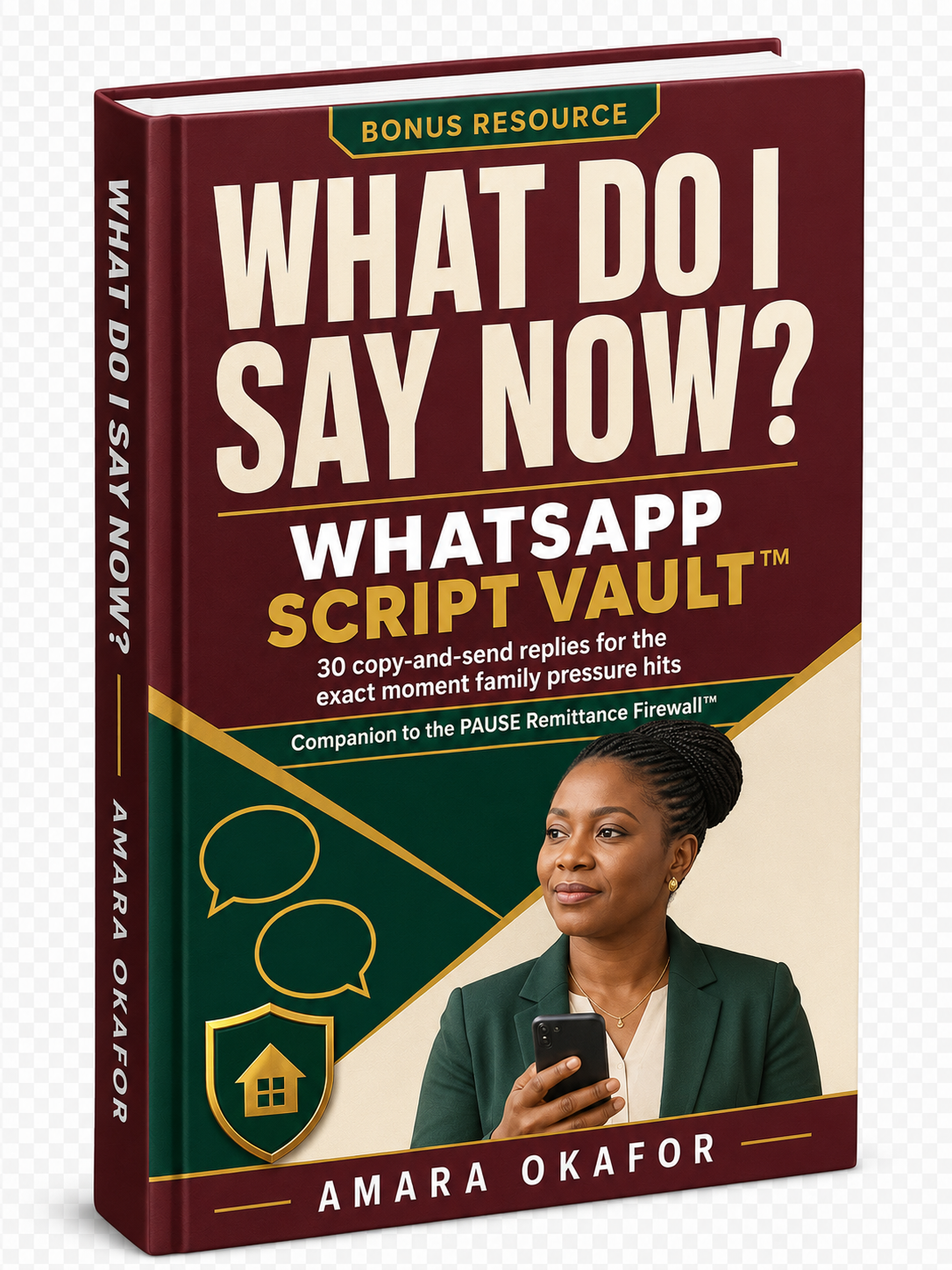
Bonus 1
The “What Do I Say Now?” WhatsApp Script Vault™
Displayed value: £9 — included with the £5 offer
Thirty copy-and-send replies for the moments when you need to pause, ask for proof, offer only part, pay a provider directly, share responsibility, refuse a repeated rescue or end the conversation without becoming rude.
The scripts are calm, respectful and firm. They help you stop rewriting the same answer ten times while guilt pushes you towards a different decision.
Everything You Are Getting Today
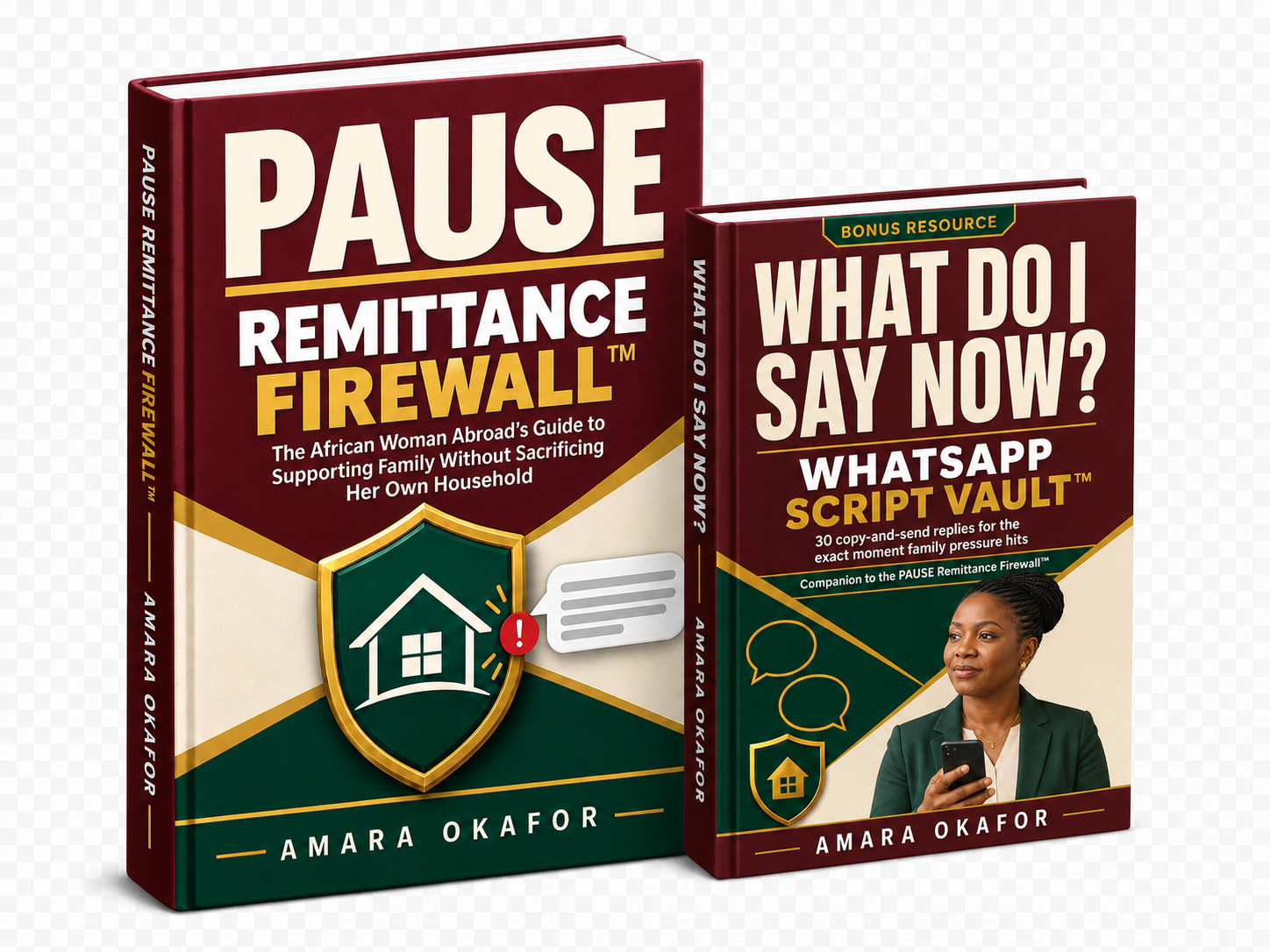
- ✓ PAUSE Remittance Firewall™ —
£15 - ✓ The “What Do I Say Now?” WhatsApp Script Vault™ —
£9
Right Now, You Have Two Choices
Choice 1: Keep deciding inside the emergency
- Open the banking app before checking your commitments.
- Move money meant for your own household.
- Explain the same answer until it changes.
- Hide transfers to avoid another argument.
- Hope the next request will be the last one.
Choice 2: Put a system before the next message
- Pause before guilt makes the promise.
- Protect your Home-First Number.
- Classify the request before funding it.
- Give family support a fixed monthly limit.
- Answer clearly without becoming cruel.
Main Guide + Bonus 1
PAUSE Remittance Firewall™
One-time payment. Digital guide. Bonus Script Vault included.
The £5 price applies while this page displays £5. No fake timer. No invented buyer limit.
Start the PAUSE Plan for £5Guarantee Terms Must Be Confirmed Before Launch
No refund promise has been supplied for this offer, so this production file does not invent one.
Before publishing: either add the exact refund/guarantee terms your checkout can honour, including eligibility and contact instructions, or remove this box entirely. Do not advertise a “30-day guarantee” unless you are prepared and able to provide it.
One Last Thing…
Picture yourself one month from today.
Will an urgent message still decide where your money goes before you check what your own household needs?
Will you know the exact amount that must stay protected?
Will you be able to tell a genuine emergency from a repeated rescue?
Will you and your partner have one agreed plan instead of another secret transfer?
Will you help because the help is safe and freely chosen—not because guilt reached your account first?
Now picture one month from today if you close the page and change nothing.
The next message may use a different name and a different reason. But without a new decision process, the same panic can lead to the same transfer and the same hole afterward.
The difference between those two versions of the month is a system you put in place before the next request arrives.
Get the Guide + Script Vault for £5If You Have Read This Far and You Are Still Hesitating—
You may not be doubting the price.
You may be wondering whether you are allowed to protect money when somebody you love still has a need.
You are.
Their need can be real. Your limit can also be real.
Buying a guide does not set the boundary for you. But a tested framework can help you stop making the same high-pressure decision from scratch every time.
This is not about choosing yourself instead of your family. It is about refusing to erase your household from the definition of family.
Stop waiting for guilt to approve the boundary. Check the numbers and make the decision.
Get PAUSE Remittance Firewall™ for £5P.S. The PAUSE system is not an automatic no. It helps you decide whether full help, partial help, direct payment, shared help, non-cash help or no financial help is safest.
P.P.S. The current advertised offer is £5 for the main guide plus Bonus 1 while this page displays that price.
P.P.P.S. Every day without a system is another day an urgent message can reach your money before your own priorities do.
With respect for your generosity—and your home,
Amara Okafor
Frequently Asked Questions
How will the guide be delivered?
The final delivery method has not yet been connected. Before publishing, configure your checkout to send the guide and Bonus 1 automatically by email, or by email plus WhatsApp, then update this answer with the exact tested process and realistic delivery time.
Is this guide telling me to stop supporting my family?
No. The framework does not force a yes or no. It helps you check what your own household needs, understand the request and choose the safest form of help. Sometimes that will be full payment. Sometimes it will be partial or direct payment. Sometimes the answer will be no.
What if the need is a genuine emergency?
The Four-Box Request Test helps you identify sudden, serious and verifiable emergencies. You can act quickly within your Safe-to-Help Amount, pay a provider directly where practical and ask other responsible people to share the cost. A genuine need still does not create money you do not safely have.
What if my family becomes angry?
A boundary can be respectful and still disappoint somebody. The guide shows you how to give one clear answer, avoid over-explaining and stop negotiating against your own limit. Their reaction is information; it is not proof that your decision is wrong.
Will this help if my partner and I already argue about family transfers?
The Home-First Number and Family Support Pot can give you shared figures to discuss instead of arguing about every request separately. The guide is educational and is not couples therapy, but it can help make the financial decision more visible and consistent.
Why is this different from ordinary budgeting advice?
Ordinary budgeting often stops before the emotional request arrives. PAUSE focuses on the pressure point: the hours between “Please, it’s urgent” and the transfer. It combines a delay script, household calculation, request test, fixed support limit and final-answer boundary.
Is there a money-back guarantee?
No guarantee terms have been confirmed for this pre-launch advertorial. The seller must add accurate refund terms before publishing or clearly state that the digital product is non-refundable where lawful and appropriate. Check the live checkout page for the final policy.
Reader Discussion
Which is harder for you: delaying the first reply, checking the real amount or keeping your answer closed after you have given it?
LikeWhat type of request most often arrives as “urgent” in your family: school fees, medicine, rent, ceremonies or business money?
LikeWould a fixed Family Support Pot make conversations with your partner easier—or would you need to agree the household priorities first?
Like